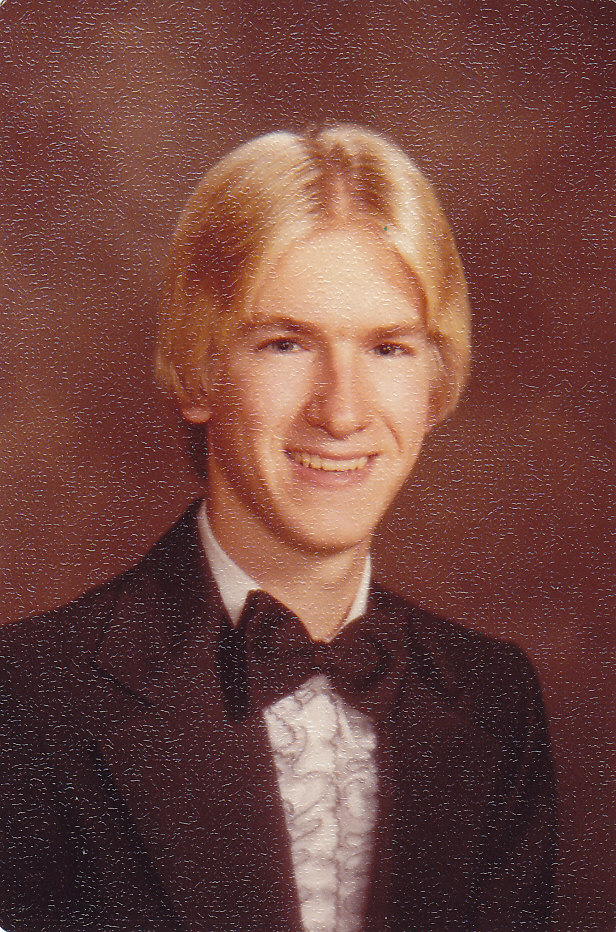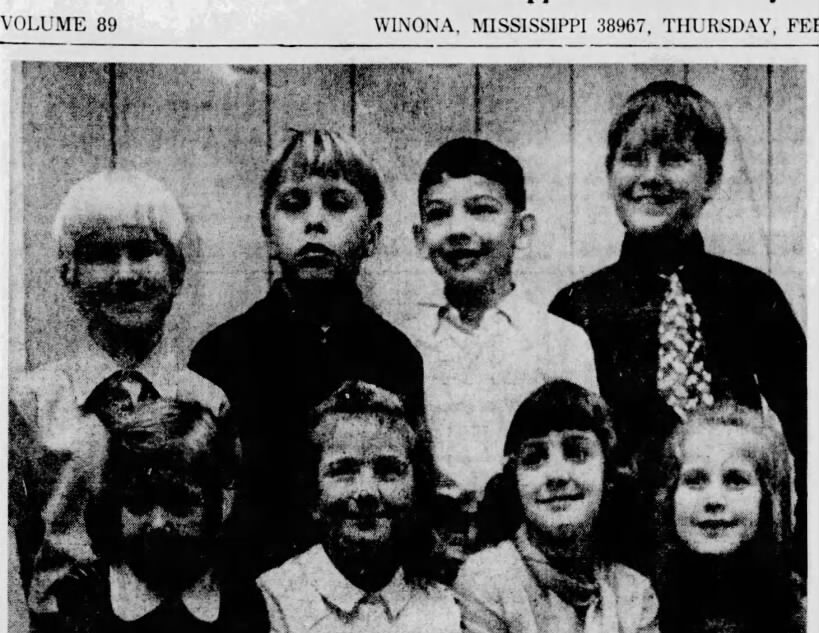
John Mark Pitner standing far left in photo.
John Mark Pitner: Winona Academy 1970, Winona High School Class of 1982, Winona, Mississippi
I acknowledge there’s evidence the Winona Academy First Grade Class Favorite of 1970 selection process was rigged from the start. For as long as I knew her, my teacher (and my mother’s good friend) Mrs. Simpson told me I was her all-time favorite student.
While I was basking in the glory of accepting my award with Mary Ann and the grades 2 to 4 favorites, plans were being made behind my back that would knock me off my high popularity horse. And I was being betrayed by my own daddy.
My daddy was in his tenth year as publisher of the local newspaper. Throughout those ten years he provided his readers with conservative social direction under the guise of editorials he described decades later as “just simple letters from home.” He was no different from any other newspaperman in a small community at the time, with a level of local influence comparable to a Kardashian in Beverly Hills.
While I was learning how to write in cursive, a skill that I absolutely use every day, my daddy had just met with Mr. Billingsly, owner of the local Piggly Wiggly, and Dr. Dulin, Superintendent of Winona Public Schools. The outcome of that meeting eventually lead to me attending Winona Public Schools at the beginning of my second grade and for the next eleven years. My glory days of popularity were over as quickly as they started.
Earlier in the 1960s, Dr. Dulin attempted to integrate Carroll County’s public schools. A young, brilliant, energetic recent college graduate with a master’s degree and a couple of years of teaching experience, he was overqualified when it came to school management. He was an education rock star, and traveled around the country, learning and listening to other teaching ideas, meeting other teacher-leaders, real rock stars, and even tough-guy movie stars like Clint Eastwood. Maybe his interaction with Clint rubbed off, an inspiration to keep his cool when a parent at an integration meeting later pointed his gun at Dr. Dulin and told him that if his daughter got harmed during all this integration nonsense the school leader was causing, he would come back and kill him. Dr. Dulin still went around Carroll County trying to get all the white and Black kids together for the betterment of us all, at least until Winona hired him to lead their public school system.
Lucky for Winona, city business leaders, like Mr. Billingsly, knew they had to elevate all kids to improve the quality of life for everyone. Industry would keep going north on Highway 51 or west on Highway 82, bypassing the Crossroads of North Mississippi if there was no educated pool of workers to draw upon to make their picture frames or auto hubcaps or screw conveyors or washing machine tubs. The grocery store owner wanted to sell more groceries, and he needed more customers and customers with more money to spend. He had the vision to see that wasn’t happening without every kid in town, white and Black, getting a great education. He correctly saw the only color in Winona that mattered was green, and he got my daddy to pay attention one day when he reminded him how much money he spent with my daddy’s paper on advertising. My daddy already knew there would be an opportunity for more green flowing through the newspaper with more local industry, and our family sure could use a newer Ford Galaxie 500 Ranch Wagon.
But my daddy was conflicted. He supported the concept of good public education and had put me in class for one day at Carroll County’s public J. Z. George school, the first day after the first year it integrated. Or more accurately the day it failed to integrate again, a self-fulfilling prophesy that he had contributed to if not outright created. Remember, he was the top local influencer of the time with his “simple letters to home” editorial comments. Here is what he published on July 11, 1969:
“This whole justice department action seems to be madness and the repercussions almost defy discussion. The situation is bad everywhere and worse in Carroll County than in some. For instance, Carroll County has nearly 2,100 Negroes in school to only 800 whites. The ratio is almost 3 to 1. Whether zoning or pairing is employed, the ratio will remain the same. Survey after survey, study after study, has shown without a shadow of a doubt that the average Negro child is from two to three years behind the average white child, and in many cases the margin is even greater. Now, in this sized classroom which may have a Negro teacher whose qualifications are also limited, the teacher will have to teach either on the white students’ level which might flunk the Negro students, or the teacher will teach on the Negro’s level which will retard the whites. Either way is tragic, and the student is the loser, facing a lifetime of effort without proper education. It’s that serious, and if this action is implemented, as it appears it will be, it may end the public school system as we have always known it. Right now, we can only wait and see.”
Yikes. He was obviously a racist. Many men who think they are in a position of authority are. My daddy had the good fortune to live long enough to exorcise his racial demons and long ago expressed remorse for being on the wrong side of all that. He helped me write a book loosely based on his past. I can tell you there is regret related to his treatment of other people. That’s between him and his Maker. But back to the story of the meeting between the men in Winona who together practically controlled what everyone read, ate, and what their children’s futures would be.
Dr. Dulin had been on a call with the federal government that day. He had an approved plan, and it was about to be put into action. He just needed the town’s top influencer at least to not torpedo it with another pining about Black and white student ratios and one retarding the other and everyone being a loser. Here is how my daddy described the interaction where Dr. Dulin put him on the spot:
“Sam, I’ve been working on plans for a long time to make the latest integration mandate work calmly and smoothly once it became certain we had to do it. I’m letting you know today because I figured you’ll want to hold space in your paper for the story.” Dr. Dulin paused to puff on his pipe. “Sam, it seems you support George Wallace in your writings. I’m wondering how firm your conviction is on his strict segregationist platform, and if it’ll impact coverage of my efforts here in Winona. I just need you to be fair with my plans when you report on it.”
My daddy said he thought he was always fair, and his reason for supporting George Wallace was states’ rights. He didn’t support the federal government stepping in and telling Mississippians how to make their own bad decisions. Wallace’s pro-segregation stance was, acceptable. But my daddy committed to not derailing Dr. Dulin’s integration effort. Besides, his class favorite son was already at the private school so it didn’t affect him personally.
But then Daddy apparently made comments about the religious aspect of private schools and how mixing the races would drag everyone down, statements that seemed to come out of a Citizens’ Schools promotional brochure produced by the segregation school’s founders, the Citizens’ Council.
Dr. Dulin had heard all that before, and quickly countered. He said something to the effect that the entire public school board was Christian. The private school couldn’t claim any type of religious or moral superiority in its leadership or in educational practices. He was (and still is at 95-ish years) a member of the First Baptist Church of Winona. A daily devotional would always be a part of his life and the students in his care. And that he had addressed the concern with students being in classes with others who would supposedly slow them down. That simply wasn’t going to happen. He planned to divide each grade into five sections, each taught at a pace that would reflect the students he had placed there. He had standardized testing procedures that he would combine with discipline assessments to place students in classes that were best suited for them and their educational goals. Students would have frequent evaluations to see if he should place them in other sections. The goal would be to elevate all students. Most importantly, he would prepare those who desired to go to college as well as those who want to start a trade after high school with a new vocational technical pathway. I can picture Dr. Dulin pointing his pipe at my daddy as he politely bullied him with the facts.
By the end of that meeting, Dr. Dulin had explained how he would also convince the school board to require all teachers must enroll their own children in the public school or they go teach at the private school. He would pressure business and other community leaders to publicly commit to sending their children to the public school. He was determined to prove to the Black parents that the school would integrate with white students. But there was a lynchpin that would hold it all together in the public’s view. A sacrificial lamb if you will.
So, to set an example, I went from an enviable position as teacher’s pet at Winona Academy to an average kid at Winona Public School in less than a year. I managed once to get the sympathy vote with a get-well card signed by the entire class after my appendectomy, but that was only a temporary bump in the popularity polls. And I was able to openly pray for a new Corvette every morning after Dr. Dulin’s devotional throughout high school. I’m pretty sure now He wouldn’t have given me one even if I was praying to Him at Winona Academy.
And so much for my daddy’s prediction in 1969 that the Black kids would drag the white kids down. Thanks to leaders like Dr. Dulin and Mr. Billingsly helping my daddy see things the right way, when I graduated from Winona High School in 1982, Alesia Clay was our class valedictorian. Her white classmates simply couldn’t best her 97.32 average.
– John Mark Pitner describes his new novel THE AGITATORS: A REMINISCENCE as historical fiction but loosely based on his family’s experiences in newspaper publishing and stories his friends have shared. His father, Sam N. Pitner, lived 99 years and passed away September 4, 2025.