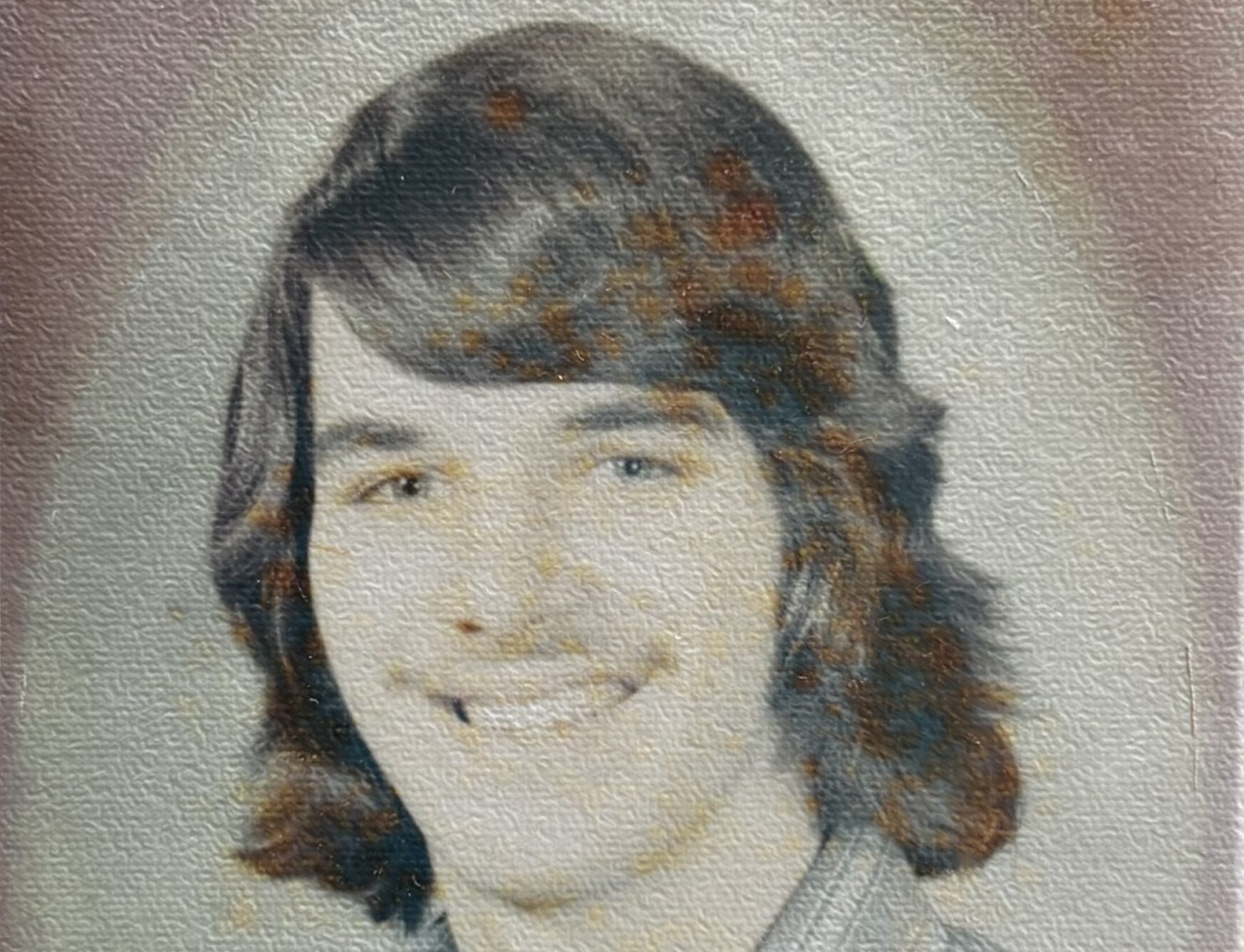
Joseph T. Reiff,
Murrah High School
Class of 1972
Jackson, Mississippi
It was spring 1970, in tenth grade English class on the second floor of Jackson Murrah High School’s east end. Fifth period. Beginning in late January, we now had authentic integration of the public schools after the U. S. Supreme Court issued its decision in Alexander v. Holmes in fall 1969. In a class of about thirty, Miss Crawford had separated the dozen or so African American students on one side of the room and us white kids over the rest of the space. I sat on the third row from the door, next to last seat.
We were doing grammar that day. To review our knowledge of simple, compound, and complex sentences, Miss Crawford had devised a game. She read a sentence and asked which of the three types it exemplified. Whoever gave the correct answer then created a sentence, read it to the class, and waited for a correct response from classmates. The person who answered correctly posed the next sentence. It became a contest between Charles Yarn, a Black guy who sat toward the front on the row farthest from the door, and me. I knew his name through roll call only; he was new to me, as were all of the African Americans in that class.
My history teacher had also put all the Black students together, in this case just inside the classroom door. She usually started the period with recitation, where she would go student to student asking factual questions from class material, and those who gave a correct answer would get a recitation point. When she got to the Black side of the room, she read their names quickly, giving each one noticeably less time to answer the question. Her disdain for and lack of interest in our new classmates was evident.
Though it was not part of my conscious thinking about the Christian faith then, I have long understood that a principle pervading the Bible is the command to give “hospitality to the stranger.” There were so many ways in which we white folks failed to do that at Murrah that spring; we gave the many new Black students a poor, even hostile “welcome.”
It reminds me of a story my late mother, Gerry Reiff, shared. She taught first grade at Jackson’s Watkins Elementary in the 1963-64 year, the last fully segregated time in the Jackson Public Schools. In fall of 1964 there were a few Black families who took advantage of “Freedom of Choice” desegregation and sent their children to traditionally white schools. I know in September 1964 there was one Black girl who entered the first grade at my school, Power Elementary. My Power and Bailey classmate Mary Ann Rodman later published a young adult fictional account of that year, Yankee Girl.
Fifty years later, Mother recalled an early 1964 conversation with some other Watkins teachers on the potential token desegregation. One teacher vehemently claimed she was not willing to teach a Black student (her actual words were probably even less kind). After a pause, another teacher said she hoped at least one of the Black children whose families were brave enough to send them to Watkins might be in her class. My mother knew that woman to be a truly hospitable Christian.
When I was in the seventh grade at Bailey Junior High in 1966, there were maybe nine Freedom of Choice students, only one male: Sammy Lee Liddell. That year I often arrived at school early, and on cold days I waited in one of the large covered doorways until the building opened. Sammy Lee usually waited there, too. A few other white boys directed an incessant barrage of verbal abuse at him, but he never responded and kept his face expressionless. I wish I had stood up for Sammy Lee, but I did not. I didn’t witness any other abuse of the few Black kids there over the next two years, but I’m sure there was some.
Murrah was still almost all white during my tenth grade first semester, but after the late 1969 Supreme Court decision, we knew things would change. My mother was a member of the Panel of American Women, an organization which did public race relations programs featuring a range of women—white and Black, Protestant, Catholic and Jewish. The Panel came to my school Murrah for an assembly after the 1969 news of change was out. Mother served as the moderator that day. I remember being relieved she didn’t share her own story and include hopes I’d expressed about race relations as a child. Now I regret being such a political coward worried about what others would think of me.
I wasn’t wrong to know my outlook would attract trouble. When it was time for audience questions, one guy asked defiantly, “How come people in the North don’t have to have their schools integrated?” One of the panelists said, “Well, they have a better track record in race relations than we do,” which drew derisive response from the somewhat hostile audience. My mother and the others ate lunch in the cafeteria afterwards while I stayed at my own table. My connection to her went public when she approached me and said good-bye. The guy seated next to me asked in astonishment, “You know that lady?!?” I said quietly, “She’s my mother.” I was proud of what she was doing but not comfortable enough to say so.
At Murrah it was traditional to hold a feature pageant each spring to name class favorites and superlatives (“Most Beautiful,” etc.). The pageant happened in December that year, however, heading off the arrival of the new Black students in January. The theme for this final time before full integration was, embarrassingly, Camelot. There were many seniors, male and female alike, who wept. I was bewildered and didn’t share the feelings, but I understand now that the intense sadness and rage reflected the popping of the bubble of our white world, the impending destruction of the wall that “protected” us from any need to relate to African Americans as peers.
And after that wall came down in early 1970, a steady stream of my white classmates left the public schools over the next two years. Judging from class photos in my sophomore and senior yearbooks, approximately two-thirds of my white sophomore classmates were gone from Murrah by our senior year in the fall of 1971, more girls than boys. Most ended up at Jackson Prep or Council Manhattan, both founded as segregation academies.
Back to Miss Crawford’s English class on that spring 1970 afternoon and the grammar contest between Charles Yarn and me. We had three or four exchanges, neither one succeeding in catching the other in a mistake. After class, Charles approached me as we neared the door and said something complimentary to acknowledge me as a worthy opponent. I did not know how to respond. I don’t think I said anything in reply. That night at home, I wanted to telephone him to reciprocate his kind words. I searched the phone book for his number, but I gave up, realizing that I knew nothing about him as a person or about the community in which he lived. Obviously, I could have pursued that at school, but I did not, I am sorry to say. I was scared to cross the color line. I think most of us, white and Black alike, were unsure how to do that in spring 1970.
But that changed in the next two years. My family lived in England for seven months in the second half of my junior year, and something happened while I was gone. I realized so in my senior year fall. I ran for student body co-president (we elected two, one Black and one white). The runoff for white co-president was between my friend Mike Stevens and me, and on that day, Mike and I walked together in the hallway between periods. I noticed how Mike greeted over a dozen Black students by name. They obviously knew him too. Watching their easy interaction, it was clear to me I wouldn’t win that election. The color line had been crossed more fully by at least some white and Black kids. For boys this happened in sports and physical education. In gym class I learned more about my male Black classmates and the way they saw the world.
Looking back on my frustration that Spring 1970 night when I confronted the huge gap between my world and Charles Yarn’s, I have often tried to imagine a different world: one in which he and I had gone to a fully integrated school together for several years and had become friends because of similar interests. That is a world I would have loved. But as a sixteen-year-old kid who lived in my head much of the time, I did not venture much out of my own narrow comfort zone, and so I failed to extend hospitality and friendship to Charles, even though he offered both to me in that moment.
Time and cultural evolution help me now better understand my own complex feelings as I tried and failed to connect with my Black classmate in spring 1970. I was the product of a culture segregated because of fear, with almost all white parents (though not my own) believing they had to keep their children separated from “them,” African Americans. That rigid segregation did great harm to Blacks, but as Fannie Lou Hamer understood, it also harmed whites.
In recent years, social science research has shown clearly that attitudes toward people who are different change for the better when we have real relationships with such people—in this case, white folks and Black folks. That research has also shown that many white folks have few if any such significant friendships across the color line. I believe inasmuch as this is true in Mississippi, it is a direct result of the abandonment of the public schools by many white families.
In my senior year of high school, I believed that by the time the children starting public school that year in Jackson had reached their senior year, things would be different. Kids starting the first grade together that year across the color line would have the opportunity to know each other as human beings and friends. I imagined this with much hope.
There was never any doubt in my mind that my younger brother and I would stay in the public schools, because our parents were deeply committed to working for change in Mississippi. My father served a term as president of Jacksonians for Public Education. It’s probably true that most of my classmates who left Murrah for segregated schools did so because their parents decided it. I can’t help but explain that decision as a failure of imagination: white parents couldn’t see their children going to school with African Americans and getting to know them as human beings, potential friends. We continue to live with that sad legacy today.
Joseph T. Reiff is Emeritus Professor of Religion at Emory & Henry University and a retired United Methodist minister. He is the author of Born of Conviction: White Methodists and Mississippi’s Closed Society (Oxford University Press, 2016, 2025).A few elements of this essay appeared in different form in Lines Were Drawn: Remembering Court-Ordered Integration at a Mississippi High School (University Press of Mississippi, 2016).