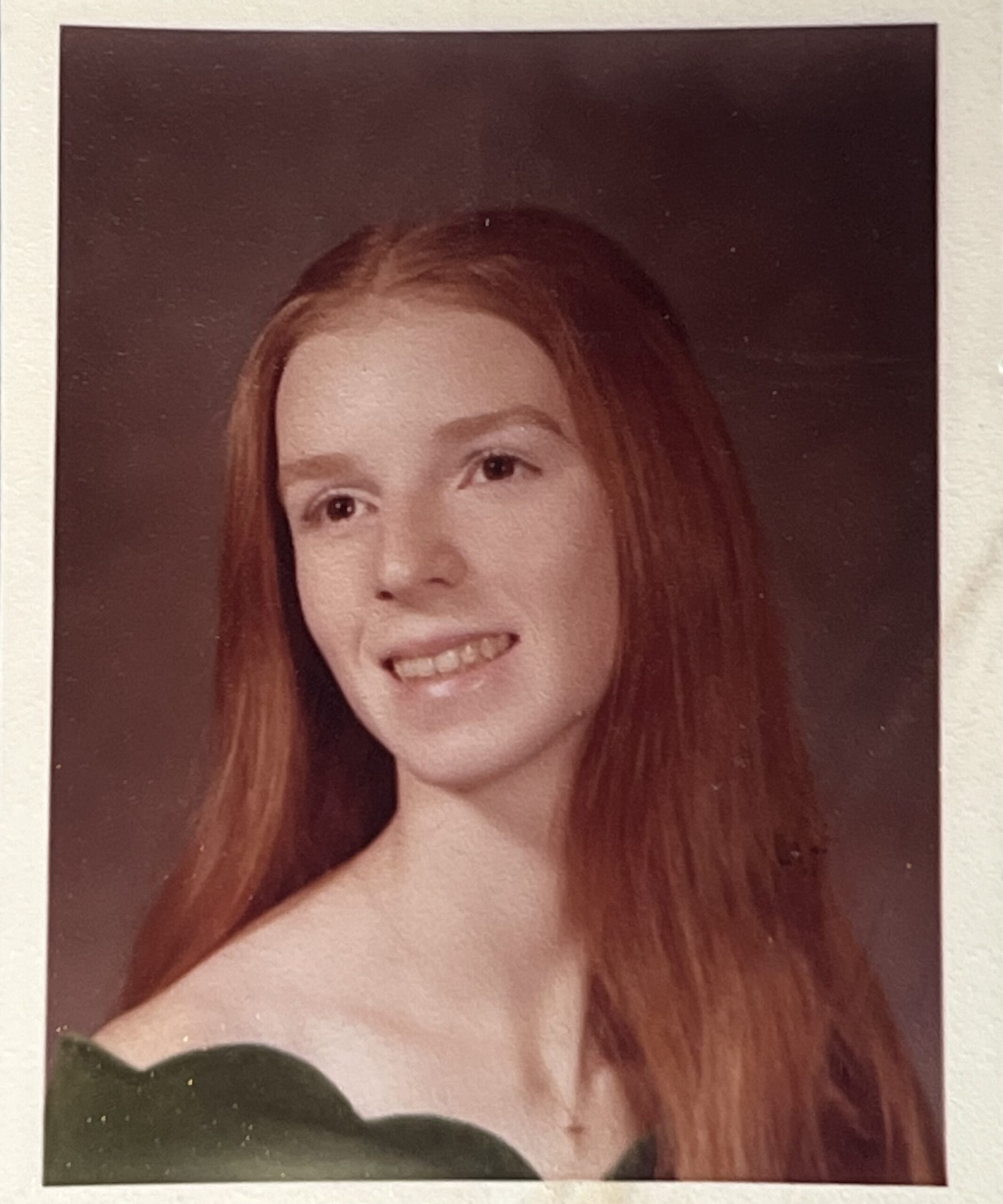
Isabelle Ezelle Higbee
Murrah High School
Class of 1974
Jackson, Mississippi
I made my way through the Jackson Public Schools at the same time that my family navigated through the civil rights-era in the city—proudly and not totally smoothly. I was proud of our choices then and even more proud now in hindsight. When is a smooth seamless life ever a guarantee?
First, my family’s story. My father, Robert Ezelle, Jr., was president-elect of the Jackson Chamber of Commerce at the time of the Civil Rights Act of 1964. There was an urgency for the Chamber to weigh in on this historic legislation as soon as possible. The president was out of town at the time so my father led the Chamber to issue a statement on the act’s passage. The chamber called for businesses to accept the law of the land until or if it were struck down. Let’s be honest – this was about economics and national image, not education. Dishearteningly but maybe unsurprisingly, just a few days later on July 9, 1964, the Mississippi Legislature adopted a resolution denouncing the Chamber’s appeal for keeping the law. So much for state image.
One more bit of family history before getting to my own school narrative. My father’s reputation as a civil rights-supporting civic leader made our family a target for the Ku Klux Klan. On May 1, 1965, a cross was burned in our yard in the city’s Belhaven neighborhood late at night. Ironically, we weren’t terrified. We slept through it – window air conditioning units blocked out a lot of exterior noise. The next morning, my mother wanted to keep some of the burned pieces as souvenirs, but when the FBI arrived, they informed her she couldn’t. The remnants were evidence in a criminal investigation, the FBI said. That was my mom. Looking back, I see how crucial her self-possession and confidence were to my well-being. She was a Belgian-born war bride who made it through near starvation in World War II outside the town of La Louviere. From that, she developed a philosophical sense of everything, good or bad, being just another curious adventure. As for my dad, he knew exactly who the main person was behind the cross burning. He chose not to pursue any action because it was complicated. He hinted that in our neighborhood, children who played together during the day had parents who showed true colors at night.
Family is fate when it comes to children’s experiences. With my parents’ civic and Methodist beliefs, there was no doubt I’d stay in the Jackson public school system once school integration began. Of course, integration was late to happen over nearly all of the South. The 1954 Brown decision called to end segregation “with all deliberate speed,” which most southern communities used as a hazy indefinite delay tactic. It was thirteen years later in 1967 before a Black student arrived at my north Jackson elementary school. I remember noticing her Sunday School-worthy dress on the first day of school. She was better dressed than anyone else in our class. She was a very good student but a little shy. Was that her natural personality, or a result of being placed in a situation where no one else looked like her? I never saw the teacher or any students mistreat her, but there was just an energy in the room about her presence. It was clear that this was something new. It started to hit me that I was living out in my education what my father was advocating for in the business world. It was as much that I was instinctively in sync with my father as it was that I was making a separate political decision myself.
The outer world kept penetrating inside our home as well. On September 18, 1967, nearby Temple Beth Israel was bombed. Two months later, bombs were placed at the homes of a Methodist minister, Bob Kochtitzky, and Rabbi Perry Nussbaum. At eleven years old, I was old enough to be very aware of what was going on. We lived in a two-story home on Belhaven’s St. Ann Street where I had a bedroom upstairs at the back of the house. Two of my brothers and my parents had bedrooms upstairs at the front of the house. I developed an advanced case of survivor’s guilt, worried that if our house was bombed, I would survive, but my brothers would not. That’s a heavy thing for an eleven year old to handle. I never talked about it to anyone. Fortunately, it was a fear that never materialized. I’ll never know if my parents thought our house being bombed was a possibility. We never talked about it at the time.
By 1968, I was in junior high, and our all-white class had its first Black teacher. She was young, calm, and limited herself to a slight Mona Lisa smile. She was a very good teacher, and I liked her very much. In my previous years with white teachers, classmates towed the line. This was the first time I experienced students acting disrespectfully in a classroom. There were a couple of boys in who sat in the back of the class. They liked to launch spitballs across the room, definitely trying to provoke her patience. She did her best with maintaining order but I know it was a very trying year for her. Were the boys doing things because they were in a class taught by a Black woman, or because they were just bullies in the making? I’d give it fifty-fifty odds either way.
The South spasmed in 1970 when the old “all deliberate speed” language of the Brown decision gave way to the “integration now” mandate of the Alexander v. Holmes case, ordered by the U.S. Supreme Court in the consolidated case involving 33 Mississippi school districts. School districts across the region were to quit stalling and thoroughly integrate. For me, that meant watching school lines redrawn in the middle of the year and seeing new breakaway all-white private schools popping up to deal with “the problem.” My parents knew what the damage could be to the public school system and the city if these private schools caught on and flourished. In 1970, Jacksonians for Public Education was created to support the efforts of the Jackson public school system. The first President? Robert L. Ezelle, Jr.
Yet whoosh…in the blink of an eye so many friends that I had gone to school with since first grade were gone. Many of us who stayed could have gone to private schools but we made the conscious decision to stay. This was a complicated time for me emotionally. In my heart I knew I was making the right decision to stay in public schooling. But there was definitely a deep sense of sorrow at losing friends, many of whom did not continue our friendship after they moved to private schools. To be honest, I felt ostracized. It hurt.
In the Jackson system’s minimal pre-1970 gestures toward integration, the results had been only a small number of Black students and teachers arriving to historically white schools. Now I’d be attending an historically Black school, about two miles from my neighborhood. I knew it would be a change. In fact, the white parents committed to staying in the public school system organized an August party for us ahead of our first day at Rowan. I think there were 29 white students in a total student population of 290. Ten percent. I loved Rowan. Our principal, Mr. Jackson, was a kind, gentle, older Black man. He took care of all his students.
Along with being a part of history in the wide public sense, I hold a sweet memory, small and human, from that year. I often wound up in the restroom at the same time as some of the Rowan special education girls. They’d never been around white classmates before. They didn’t bother to hide their interest in our different hair. We had repeated bathroom moments when they paused to scrutinize the long locks of the white girls, mine included. They’d run their hands through our hair before heading back to class. Definitely a new curious experience for me.
The Rowan faculty, mostly Black, were good teachers. Most of our teachers were welcoming but there was a history teacher who was not good at hiding her dislike of having white students in her class. That was awkward. Chalk it up to just another life lesson in how to deal with uncomfortable not-ideal situations. For me, Rowan was great. I can still picture a friend and me walking down the Rowan hall in our white and purple Rowan sweatshirts, Seventies purple bell bottoms and saddle oxfords with bells attached feeling very cool.
The next big change came when we were assigned to Brinkley for the tenth grade. That turned into a harder year. It was twice as big as Rowan had been and had exponentially more friction. Was it the school administration’s laxity or was the energy inevitable? I don’t know. Fights would occasionally break out in the halls, some racially motivated. There were two male teachers who would venture out to break up a fight. One was my math teacher Mr. Rollo. The other was a coach who walked down the halls swinging a chain about three feet long. That definitely deterred young men thinking about starting a fight. Mrs. Adams, my Latin teacher, would simply close the classroom door and continue to teach while the hall situation played itself out.
Although we never actually had a problem, my friends and I would get football player friends to stand outside the restroom door at Brinkley. If we didn’t come out in five minutes, the plan would be for them to come in to “rescue us.” Really, that just makes me laugh now. But at the time we apparently thought it was a prudent thing to do.
The next two years, we made it to the city’s traditional white flagship Murrah High School. A share of white students who fled to private schools with integration came back to Murrah for their final two years. The school had been a north Jackson institution since its opening in the Eisenhower era. Many wanted to graduate from the same high school as their older siblings. I was one of those since my three older brothers graduated from Murrah during the pre-integration years. During my years at Murrah, the racial mix was about 60/40. I can’t remember if that was 60/40 white to black or black to white. Why can’t I remember? Because it just wasn’t an issue.
My school years tracked the same critical Sixties and Seventies timeline as school integration in Jackson. We were the first products of integration, and it succeeded. I wish that were the end of the story. Unfortunately, after our class graduated in 1974, the momentum for a truly integrated school seemed to lose steam. Despite Murrah’s successful integration, year by year, the share of white students decreased at Murrah. U.S. News and World Reports statistics currently list Murrah’s enrollment breakdown as 95 percent Black and 5 percent Hispanic, white and multi-racial.
I often wonder what a different position Jackson, the city, would be in now if the momentum and success of 1974 had continued to build.
Isabelle Ezelle Higbee is 1978 Millsaps College graduate. After several career chapters, she returned to Millsaps in Jackson, Mississippi as director of financial aid. Since retired from that position, she continues to work at the college part time. She has finished a novel based on the World War II Underground experience of her mother and her mother’s family and friends, Victory Will Come: From Occupied Belgium 1940 to 1945.
I was a part of the “integration now” mandate, and I also remained in the public school system. This is an accurate account of our school years from the 9th grade through our senior year. There were bad times and good times as with most life experiences. We learned to get along with each other most of the time. I made lifelong friendships as a result of this time in school that I would never have had without this change. For that alone, I am thankful.
Well said!
Isabelle, thanks for the wonderful reminder of our experience staying in public schools, rather than bolting to private schools. So much I never knew about your family! It was an experience, both good and bad, but so happy I stayed in public schools. Unfortunately, the Jackson public schools have never recovered.
Isabelle, so very eloquent! You reminded me of so many good memories. I have often said that that year at Rowan was probably the best educational year of my life, educational in so many ways. Thank you so much for this wonderful description of those years. 💙
During the time our schools were being integrated I knew this would add fuel to the social tension in the city. Growing up on the wrong side of the tracks even within my Black neighborhood, in a household with both my parents being blind there were those that perceived me as behind the curve ball. However, I saw it as an advantage as my parents could only gauge a person’s character not by the color of their skin but in how they were treated with each and every interaction with the “sighted-folks”.
So, as we students were merged into unfamiliar school hallways with unfamiliar teachers and most importantly unfamiliar classmates, the tension was thick. Those school years made me feel somewhat like a ball being bounced off the cushions of a pool table. It seemed that with every school break my neighborhood had new district maps drawn. During the last two years of high school, I finally settled in at William B. Murrah where a sense of school spirit and pride developed within me as member of the Class of 1974 Graduates. Childhood friends were displaced but I met many other people to add to the list that I consider friends.
I simply followed the example which my parents had set for me my entire life and gauged individuals, and not a race.